
Project archive guide. Technical instructions are awaiting hardware-team review; consult the documentation for your exact equipment.
Electronic Speed Controllers
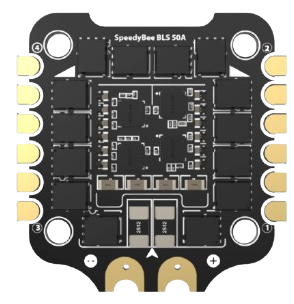
An Electronic Speed Controller is the critical interface between the flight controller and the drone’s motors. It converts the low-power control signals from the flight controller into high-power, precisely timed electrical pulses that drive each motor. Modern ESCs employ advanced firmware to optimize motor performance, improve efficiency, and provide real-time telemetry such as RPM, voltage, and current draw. This allows for fine-tuned control, smoother flight characteristics, and reliable power delivery under demanding conditions.
Key Information to Know
Amperage Rating
The maximum continuous current the ESC can handle, usually given in amps (e.g., 45A). Must match or exceed your motor and prop requirements.
Voltage Rating
The supported battery cell count (e.g., 3–6S). Using a higher voltage than rated can instantly damage the ESC.
Firmware
Most modern ESCs use BLHeli_S or BLHeli_32 firmware, controlling motor response, direction, and features like RPM filtering.
Protocol
The signal type from the flight controller, such as DShot, ProShot, or PWM. Digital protocols like DShot are more reliable and allow features like turtle mode.
Telemetry
Some ESCs send data back to the flight controller, including motor RPM, temperature, voltage, and current draw, for real-time monitoring.
Temperature Management
Excess heat can damage the ESC. Good airflow, correct prop size, and avoiding overloading help keep temps safe.
Amperage Rating
The amperage rating tells you the maximum continuous current your ESC can safely handle, measured in amps (A). Choosing an ESC with an amperage rating lower than your motor’s current draw risks overheating and permanent damage. Tip: Always select an ESC rated at or above your motor and prop combo’s peak current for reliability and safety.
Voltage Rating
This rating indicates the maximum battery voltage the ESC supports, often listed as the number of LiPo cells (e.g., 3S to 6S). Using a battery with a higher voltage than the ESC rating can cause immediate failure or fire. Important: Match your ESC’s voltage rating to your battery pack to ensure safe and stable operation.
Firmware
ESC firmware such as BLHeli_S, BLHeli_32, or KISS controls how the ESC interprets throttle commands and manages motor power. Firmware updates improve performance, add features like RPM filtering, and can fix bugs or compatibility issues. Note: Flashing the correct firmware version is critical to avoid bricking your ESC.
Protocol
Protocols define how the flight controller sends throttle commands to the ESC. Traditional PWM is slower and less precise, while digital protocols like DShot and ProShot provide faster, error-checked communication. Digital protocols enable advanced features such as “turtle mode” (flip recovery) and smoother throttle response.
Telemetry
Telemetry allows the ESC to send real-time data back to the flight controller, including motor RPM, ESC temperature, voltage, and current. This data can be displayed on your OSD or logged for tuning and troubleshooting. Tip: Not all ESCs support telemetry — check specs if this is important to you.
Temperature Management
ESCs generate heat during operation, especially under heavy load or aggressive flying. Proper cooling through airflow, heatsinks, or mounting location is essential to prevent thermal shutdown or damage. Using appropriately sized motors and props reduces stress and helps keep temperatures within safe limits.
ESC Pad Deep Dive
BEC (Battery Eliminator Circuit)
Many ESCs include a built-in BEC that supplies regulated power (usually 5V or 12V) to other components like the flight controller and receiver. Why it matters: Make sure your ESC’s BEC can provide enough current for all connected devices, or consider using an external power source to avoid brownouts during flight.
Continuous vs. Burst Current
ESCs have a continuous current rating (max current they can handle indefinitely) and a burst or peak current rating (short duration high current). Why it matters: Select an ESC with a continuous current rating that meets or exceeds your motor and prop requirements to ensure reliability and avoid overheating.
ESC Timing
ESC timing controls how the ESC drives the motor coils and can be automatic or manually set (low, medium, high). Incorrect timing settings can reduce efficiency and cause motor heating. Adjust timing based on your motor type and performance needs.
BLHeli Configurator & Tools
BLHeli Configurator is the main software for flashing and tuning ESC firmware. You can use it to adjust motor direction, startup power, braking, and other performance settings tailored to your drone build.
ESC Brake
Some ESCs support braking to stop motors immediately when throttle is cut, useful for quick stops during acrobatic maneuvers or precise landing. Enable or disable brake mode in your ESC firmware depending on your flying style.
Startup Power
Startup power is the initial power sent to the motors when you apply throttle. Too low startup power may cause motors to hesitate or stutter, while too high can lead to jerky movements. Proper tuning improves throttle smoothness and responsiveness.
Current Sensor Accuracy
If your ESC includes current sensing, its accuracy affects battery monitoring and telemetry. Accurate current readings help prevent over-discharge and allow better power management during flight.
Signal Filtering
Some ESCs include filtering options to reduce electrical noise and signal interference, resulting in smoother throttle response and less jitter. Proper filtering enhances flight stability and motor control.
Physical Size & Weight
ESC dimensions and weight can impact your drone’s overall mass and balance. Smaller, lighter ESCs are preferred in racing and freestyle drones to improve agility and flight time.
Waterproofing & Durability
Some ESCs have protective coatings or rugged designs to withstand moisture, dirt, and crashes. Consider these features if you fly in harsh environments or expect heavy use.